PageRank is a way of estimating how important a web page is from the links pointing to it. Larry Page and Sergey Brin described it in the research that became Google, and it was one of the systems Google used when it launched. Google’s current guide to its ranking systems says PageRank has “evolved a lot since then” and “continues to be part of our core ranking systems.”
How PageRank works
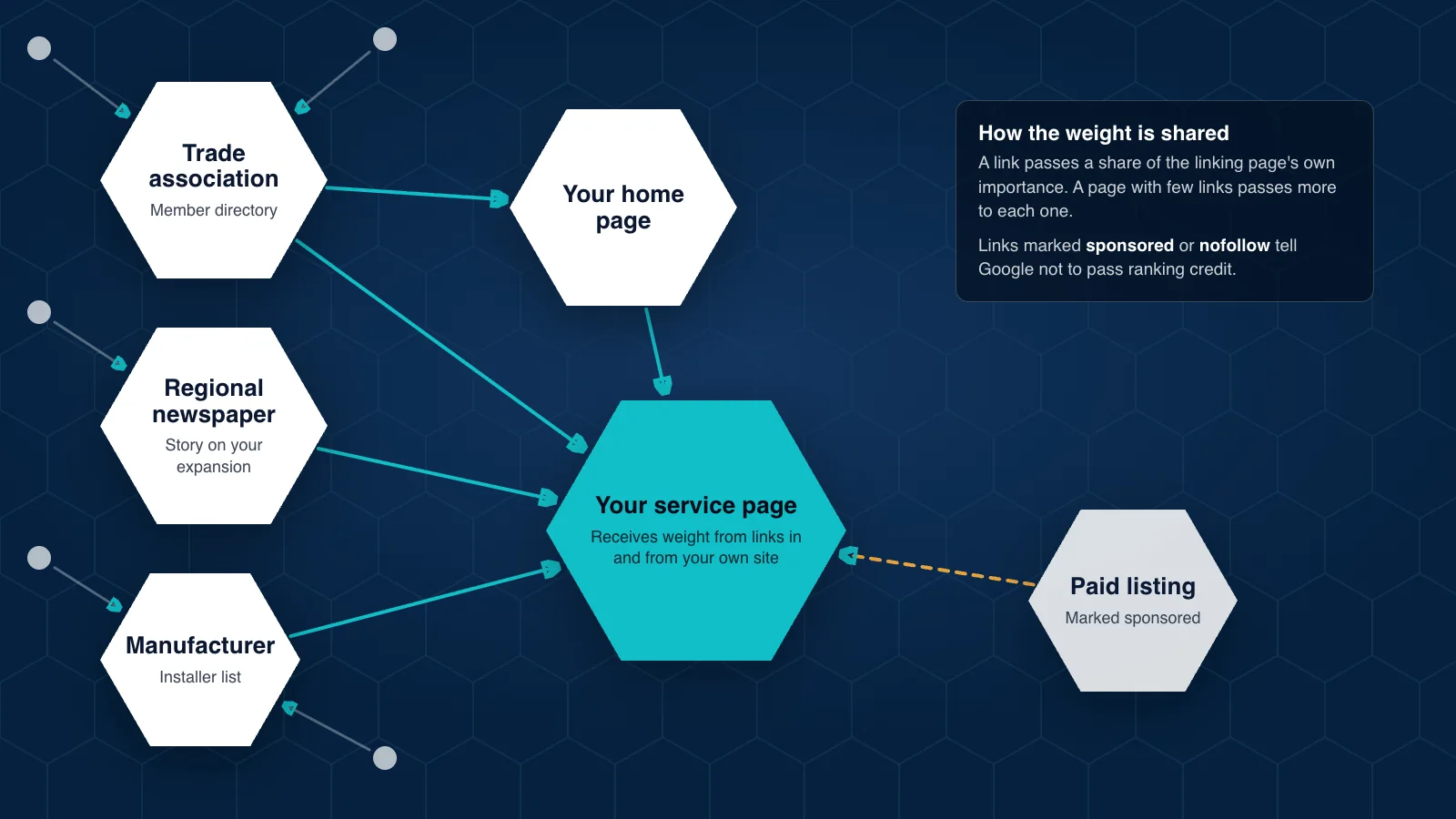
The idea is simple. A link from one page to another is treated as a vote. A page that receives many links is probably useful, and a link from a page that is itself well linked counts for more than a link from a page nobody links to. The importance a page has is shared out across the links on it, so a page with a handful of links passes more to each of them than a page with hundreds.
That is why one link from a respected trade association, a supplier or a regional newspaper can matter more than dozens of links from directories nobody visits.
The public PageRank score is gone
For years, Google showed a PageRank score from 0 to 10 in its browser toolbar. Site owners watched it closely, and an industry grew up around buying and selling links on high-scoring pages. Google stopped updating that public score and later retired it entirely. Any “PageRank” number you see in a tool today is that tool’s own estimate, not a figure from Google.
What changed since the original paper
Three things matter for a business site today.
- Links are one signal among many. Google’s SEO starter guide says PageRank “is one of the fundamental algorithms at Google” but that “there’s much more to Google Search than just links.” Relevance to the search, the quality of the content and page experience all play a part.
- Google reads the context of a link. The words in and around a link help Google understand what the destination page is about, which is why descriptive link text is better than “click here.”
- Manipulated links are spam. Google’s spam policies list buying or selling links for ranking, excessive link exchanges, automated link building and low-quality directory links as link spam. Paid and sponsored links are allowed if they are marked with
rel="sponsored"orrel="nofollow", which tells Google not to pass ranking credit through them.
What it means for your site
The practical lessons from PageRank have not changed much, even though the system has.
Earn links from places your customers trust
Links that come from real relationships tend to be the ones that count: the associations you belong to, the manufacturers whose products you install, the events you sponsor, the local paper that covered your expansion. Our article on long-term SEO covers how to earn them.
Use your own internal links on purpose
PageRank flows within your site too. If your most important service page is buried three clicks deep and only linked from the footer, it receives little of the weight your home page has earned. Link to key pages from the navigation, from related pages and from articles that discuss the same subject.
Do not chase a score
Because there is no public PageRank, there is nothing to optimize directly. Tools that estimate link strength are useful for comparing sites, but the goal is links that a person would follow and value, not a higher number in a third-party report.
PageRank in AI answers
Google says its AI features, including AI Overviews and AI Mode, draw on the same index and the same SEO fundamentals as the rest of Search, with no extra requirements. A page that ranks well for the right reasons, including being linked from trusted places, is in a better position to be cited there too. Our article on how SEO works explains the full path from crawling to ranking.