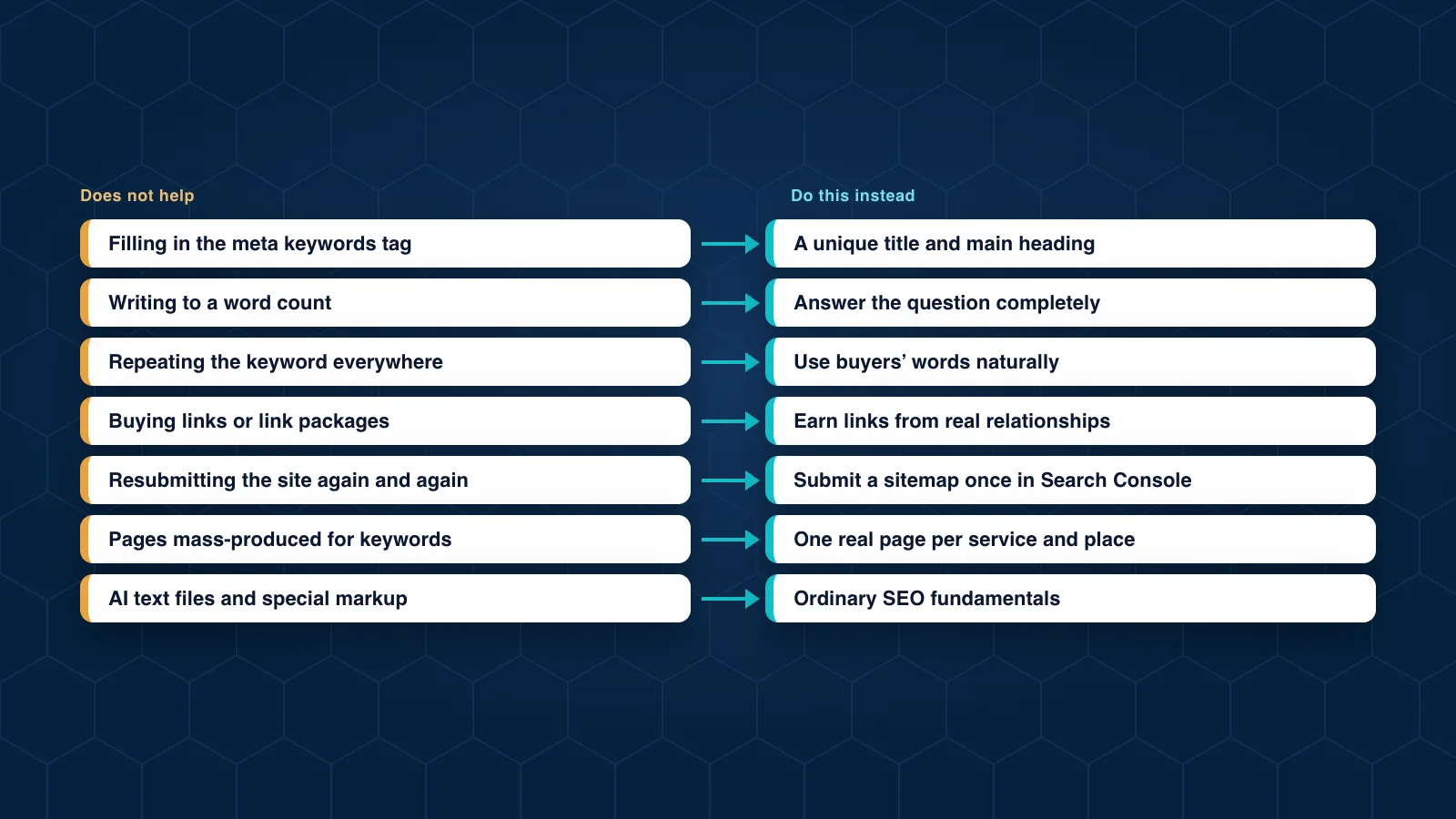
Each of these comes up regularly in proposals and audits. For each one, we have noted what Google itself says and what to do instead.
1. Filling in the meta keywords tag
The keywords meta tag lets a page list the words it wants to rank for. Google’s SEO starter guide is direct about it: “Google Search doesn’t use the keywords meta tag.” Time spent choosing meta keywords is time not spent on the page title, the headings and the content, which Google does read.
Instead: write a unique, descriptive title and a clear main heading for each page.
2. Writing to a word count
There is no ideal length. Google’s starter guide says “the length of the content alone doesn’t matter for ranking purposes,” and its guidance on helpful content lists writing to a particular word count as a warning sign. Padding a page to reach 2,000 words makes it harder to read without making it more useful.
Instead: cover the question completely, then stop. Some answers take 300 words and some take 3,000.
3. Repeating the keyword everywhere
Repeating a phrase in every paragraph, stacking lists of city names, or stuffing keywords into image alt text is keyword stuffing, which Google’s spam policies prohibit. It also reads badly to the buyer you are trying to persuade.
Instead: use the words your buyers use, naturally, and cover the related topics they care about.
4. Buying links or link packages
Packages that promise hundreds of links, link exchanges, paid guest posts with keyword-rich links, and links from low-quality directories are all named as link spam in Google’s spam policies. At best they are ignored. At worst they lead to a manual action that removes pages from the results.
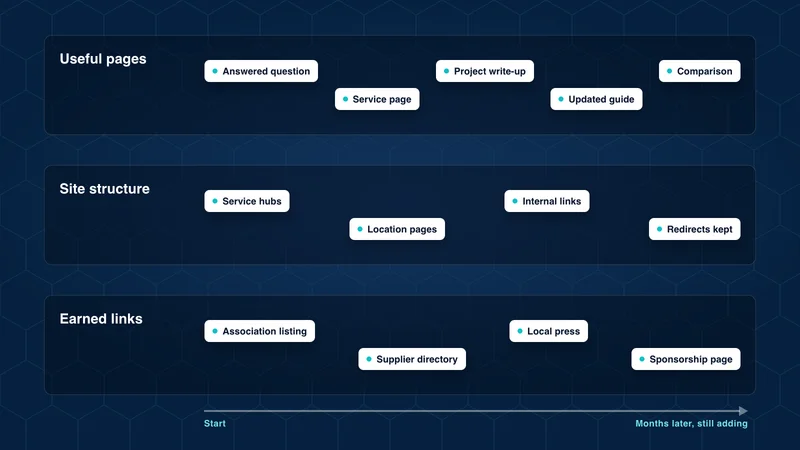
Instead: earn links through associations, partners, press and useful resources, as described in our article on long-term SEO.
5. Submitting your site to search engines over and over
Google finds most pages by following links and reading sitemaps. Paid services that “submit your site to 500 search engines” do nothing useful, and there is no benefit in repeatedly asking Google to recrawl a page that has not changed.
Instead: verify your site in Google Search Console, submit a sitemap once, and use URL Inspection to request indexing when you publish or substantially update an important page.
6. Publishing pages in bulk to cover every keyword
Generating hundreds of near-identical pages, such as one per town with only the name swapped, or using AI tools to publish large amounts of text without real review, falls under what Google calls scaled content abuse. “No matter how it’s created,” Google says, pages made primarily to manipulate rankings are a violation.
Instead: create a page for each real service and location you serve, with facts specific to it, such as the team, the projects and the area covered.
7. Adding special files or markup for AI answers
Some services now sell “AI optimization” in the form of special text files or schema meant to get you into AI answers. Google’s documentation on its AI features says: “You don’t need to create new machine readable files, AI text files, or markup to appear in these features,” and “there’s also no special schema.org structured data that you need to add.”
Instead: apply ordinary SEO fundamentals. Google says pages only need to be indexed and eligible to appear with a snippet, and that structured data, where you use it, should match the visible text on the page.
A note on E-E-A-T
E-E-A-T stands for experience, expertise, authoritativeness and trustworthiness. It is a useful way to think about quality, but Google’s starter guide answers the question of whether it is a ranking factor with “No, it’s not.” Adding an “expert” badge or a long author bio will not move rankings by itself. Showing real experience and being trustworthy does help, and our article on E-E-A-T and YMYL explains the difference.
What does work
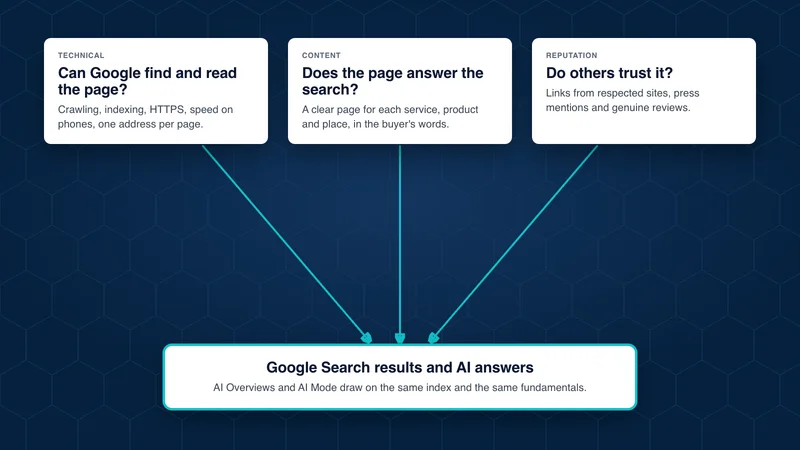
The work that pays off is less exciting than any of these shortcuts: a site Google can crawl, pages that answer the searches your buyers make, a fast experience on phones, and a reputation that other sites reference. What is SEO? explains each part.